
ELLA CARNALL HALL
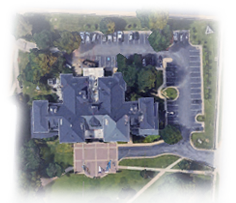
Ella Carnall Hall, built as a young womens dormitory in 1906, was one of six new buildings on the campus completed that year. Carnall Hall is located at the extreme northeast corner of the campus, on the southwest corner of Maple Street and Arkansas Avenue.
Carnall Hall is named for Miss Ella Howison Carnall, associate professor of English and modern languages at the University from 1891-1894. She had been a teacher in the Universitys Preparatory Department from 1881-84. She died in Fort Smith on March 30, 1894. Because of her excellence as a student and her later success as a teacher and role model for young women, the building was named in her memory.

All six buildings finished in 1906 were funded in 1905 by the Arkansas Legislature which appropriated $90,000 for their construction. The other five buildings were a dormitory for young men (Gray Hall), a Science Hall (Chemistry Building), an Infirmary, an Agricultural Hall, and a Dairy Building. Ella Carnall Hall was by far the most costly of the six buildings and $35,000 was appropriated for its construction.
Architects were quickly employed by the Board of Trustees in July of 1905 to design the six buildings. The architectural firm of C. L. Thompson and O. L. Gates of Little Rock designed the two dormitories and the Chemistry Building. The firm of Reed and Heckenlivley of Springfield designed the other three buildings. Bids for the combined construction of all six buildings were opened in Fayetteville on September 9, 1905 and the contract was awarded to Donaghey and McIlroy (George W. Donaghey of Conway and J. H. McIlroy of Fayetteville) for $96,450. (This is the same George W. Donaghey who was later governor of Arkansas from 1909 to 1913.) Since this exceeded the amount appropriated by the Legislature, construction was delayed until additional funds were made available. In June of 1906 the Board, upon recommendation of the governor and the building committee, authorized extra bills amounting to $1,572.82 to be paid to Donaghey and McIlroy. It is not known how much of these two overages applied to Carnall Hall, so the $35,000 figure is all we have. However, we do know that the Legislature appropriated $2,500 for furnishing both Gray Hall and Carnall Hall. In August of 1906 the building committee approved a $2,500 contract for Nesbit-McMillan to furnish the girls dormitory. It said, The boys dormitory will not be furnished on account of the lack of funds.
Colonial Revival in its design influence and detailing, Carnall Hall features an unusual additive composition in an ingenious plan to build a long, sprawling structure and still maintain relatively small scale and remain picturesque in nature. Together with a marked verticality, this lends the building to a Victorian architectural design. This was typical of other Thompson-Gates transitional buildings. The building is red brick masonry construction.
Ella Carnall Hall was definitely a priority! There had been no dormitory for young women while two new ones had been built for young menBuchanan Hall and Hill Hall. The original frame buildings on campus, known later as Stewards Hall, were also used as a boys dorm, but they were torn down about 1901. Carnall Hall was designed to be complete within itself, having its own toilets and bathrooms, dining room, kitchen, and an independent steam heating plant. This was unlike the existing dorms for young men and the new one being built (Gray Hall). The young men had a separate building for toilet and bathing facilities.
The placement of Carnall Hall on the extreme edge of the campus was most likely done for a purpose. It was put the furtherest distance on campus from the boys dorms. The separation of the sexes on college campuses was very important until the latter part of the 20th century.
In 1921 a committee named by the U.S. Commissioner of Education inspected the
University of Arkansas campus and published a very lengthy report, part of which was very critical of the campus buildings. Only three structures were singled out as being worthy of inclusion in the future development of the campus. Those three buildings were Old Main, Peabody Hall, and Carnall Hall.
In 1939 the large porches around the southeast and southwest corners of the building were removed. In 1940 the red brick structure was painted a cream white to better harmonize with the newer white limestone buildings. Between 1959 and 1960 the Buildings and Grounds Department undertook extensive remodeling and modernizing of the 1906 structure and received a special recognition from the board for their work.
Ella Carnall Hall was no longer used for a womens dorm after 1967; however, it was not used during the 1959-60 year because the building of Fulbright Hall freed up necessary space for women studentstemporarily. More residence halls were built in succeeding years, but finally when Pomfret Housing Complex was opened in 1967, Carnall Hall was no longer a residence hall for women. In 1969 the Phi Gamma Delta (Fijis) fraternity began using Carnall Hall as their fraternity house and they remained there until 1977. Part of the time the Fijis were there the anthropology department used space on the third floor and in 1973 the geography department moved to Carnall. The sociology department moved to Carnall Hall in 1979.
Ella Carnall Hall was accepted for listing in the National Register of Historic Places in December of 1982.
Carnall Hall ceased being used for offices or classrooms in 1991 when the restoration work on Old Main was completed and the sociology and geography departments were moved to Old Main and Ozark Hall. Many times in the succeeding years it appeared that Carnall Hall would be demolished because of its age and condition. Local people, led by Paula Marinoni, and former residents of the dorm fought to save the building and find a new use for a refurbished structure.
Several plans were advanced for the use of a remodeled Carnall Hall and the board
employed Cromwell Architects and Engineers in November of 1992 to devise a plan that would accommodate some University departments. Funding became a problem and that plan was not followed. New plans began to emerge that would involve some funding by private sources.

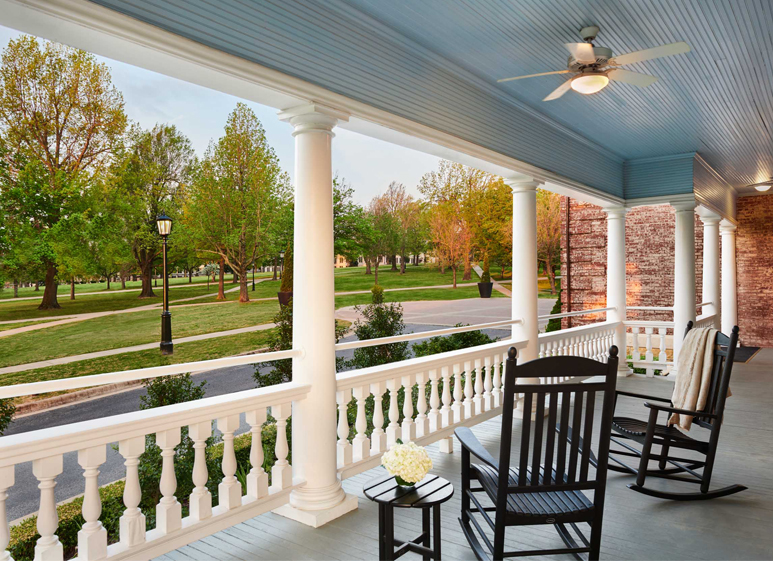
Ella Carnall Hall began to take on a new life October 2, 2001, when the Universitys Board of Trustees approved a plan for a private developer, Carnall Inn Development Co. LLC, to turn the structure into an historic hotel and restaurant. James Lambeth was the lead architect for the project, with May Construction Company the contractor. The $6.9 million project, funded by both state and private money was completed in early August of 2003.
A dedication ceremony was held September 23, 2003 for the Inn at Carnall Hall and Ellas Restaurant. Many former residents of Carnall Hall were present and many spent the night in their old home in or near their former dorm room.
Don Schaefer, University of Arkansas Publications Manager Emeritus - 10/1/2003
|